ASTM A105 is the standard specification for forged carbon steel piping components. When it comes to flanges, A105 is the most common material you will find. It is the default choice for countless general-purpose industrial applications.
This guide explains what A105 is, its properties, and when to use it.
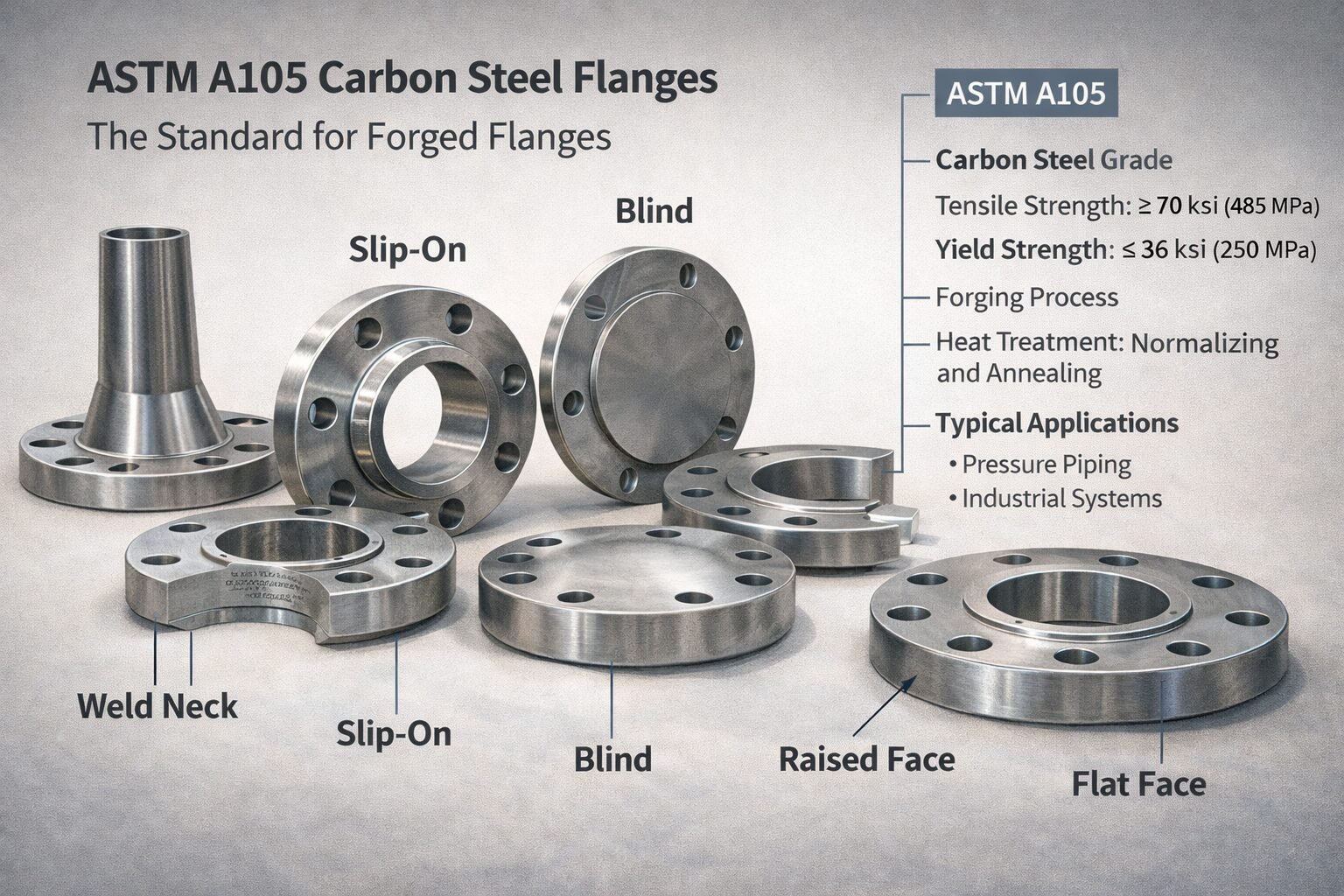
What is ASTM A105?
ASTM A105 is a material standard published by ASTM International. The “A” stands for ferrous metals, and “105” is the specific designation for this grade of carbon steel.
The key word is “forged.” A105 components are made by hammering or pressing heated steel into shape. This forging process creates a strong, uniform grain structure that is ideal for pressure-containing parts like flanges, fittings, and valves.
In simple terms: if you need a standard carbon steel weld neck, slip-on, blind, or threaded flange, you are likely specifying ASTM A105.
Key Properties and Specifications
A105 defines both the chemical composition and the mechanical (strength) properties of the steel.
Chemical Composition (Maximum % Values)
A105 is a low to medium carbon steel. Its composition ensures good strength and weldability.
| Element | Content |
| Carbon (C) | 0.35% |
| Manganese (Mn) | 0.60-1.05% |
| Phosphorus (P) | 0.035% |
| Sulfur (S) | 0.040% |
| Silicon (Si) | 0.10-0.35% |
Mechanical Properties
These are the minimum strength values A105 must meet.
| Property | Value |
| Tensile Strength | 70 ksi (485 MPa) min |
| Yield Strength | 36 ksi (250 MPa) min |
| Elongation | 22% min |
Heat Treatment: A105 flanges may be supplied in the as-forged condition. However, for certain pressure classes (like Class 400 and above) or specific service conditions, they are often normalized. Normalizing is a heat treatment that refines the grain structure for better strength and toughness.
Pressure-Temperature Ratings and Applications
A105 flanges are rated for pressure according to standards like ASME B16.5. But the “Class” (150, 300, etc.) is not a direct pressure rating.
The maximum allowed working pressure depends on the operating temperature. As temperature increases, the safe pressure for the same flange decreases. You must check a Pressure-Temperature (P-T) rating table.
Example: A105 Pressure-Temperature Relationship (ASME B16.5)
| Temperature (°F) | Max. Pressure – Class 150 (psi) | Max. Pressure – Class 300 (psi) |
| 100°F | 285 psi | 740 psi |
| 400°F | 95 psi | 505 psi |
| 600°F | 31 psi | 200 psi |
Common Applications for A105 Flanges:
- General plant water, air, and steam lines (low to moderate temperature)
- Oil and gas pipelines (onshore, non-sour service)
- Power generation (non-critical auxiliary systems)
- Petrochemical and refining plants (general service)
- HVAC and fire protection systems
A105 vs. Other Common Carbon Steel Flange Materials
A105 is for forged parts. Other specifications are used for different manufacturing methods or service conditions.
| Material Spec | Common Form | Key Difference from A105 |
| ASTM A350 LF2 | Forged | A low-temperature carbon steel. Used for sub-zero services where A105 could become brittle. |
| ASTM A694 (F42, F52, etc.) | Forged | A high-yield strength steel for high-pressure pipeline applications. |
| ASTM A516 Gr. 70 | Plate | Used for flanges cut from plate (e.g., large blinds, plate flanges). A105 is for forged shapes. |
Frequently Asked Questions
Q: Is A105 the same as “mild steel”?
A: They are similar, but not identical. “Mild steel” is a general term for low-carbon steel. A105 is a specific forged grade with defined chemistry and strength properties suitable for pressure applications.
Q: What pipe material matches an A105 flange?
A: The most common matching pipe material is ASTM A106 Grade B for seamless pipe. For welded pipe, it’s often ASTM A53 Grade B. The matching forged fitting material is ASTM A234 WPB.
Q: Can A105 be used for low-temperature service?
A: Generally, no. A105 is not designed for sub-zero temperatures. For services below -20°F (-29°C), you should specify a low-temperature material like ASTM A350 LF2, which has better impact resistance.
Q: What does “A105N” mean?
A: The “N” stands for normalized. A105N has undergone a normalizing heat treatment. This is often required for higher pressure classes to ensure optimal mechanical properties.
Q: Are A105 flanges corrosion-resistant?
A: No. Carbon steel, including A105, will rust when exposed to water and air. For corrosive environments, you need protective coatings (galvanizing, paint) or a different material like stainless steel (A182).
Conclusion
ASTM A105 is the workhorse material for forged carbon steel flanges. It offers a great balance of strength, weldability, and cost for a huge range of standard industrial services. Success depends on matching it to the correct pressure-temperature conditions and ensuring it’s compatible with your system’s environment.
Need A105 flanges for your next project? We supply a full range of ASTM A105 flanges in all types and pressure classes, with full material certification. Submit your specifications for a quote: http://texasflange.com/lp12/