Choosing between a slip-on flange and a weld neck flange is a common decision in piping design. The right choice affects your system’s safety, cost, and long-term reliability. This article explains the differences to help you make an informed choice.
Key Differences at a Glance
Here is a direct comparison of the main features:
| Feature | Slip-On Flange | Weld Neck Flange |
| Connection Method | Slides over pipe; secured by two fillet welds (inside and outside). | Butt-welded to pipe with a single full-penetration weld. |
| Pressure & Strength | Lower. Suitable for low to medium pressure. Estimated strength is about two-thirds that of a weld neck. | High. Designed for high-pressure, high-temperature, and high-stress systems. |
| Fatigue Life | Lower. Estimated to be about one-third that of a weld neck flange. | Excellent. The tapered hub distributes stress, resisting repeated bending and vibration. |
| Installation & Cost | Easier and faster to align and weld. Lower initial material and installation cost. | Requires more skilled welding and time. Higher initial cost due to more material and complex welding. |
| Bore & Flow | The bore is slightly larger than the pipe. Can cause minor turbulence. | Bore is matched to the pipe’s inner diameter for a smooth, unrestricted flow transition. |
| Common Applications | Water lines, HVAC, low-pressure process lines, fire protection systems. | Refineries, chemical plants, power generation, steam lines, critical high-pressure services. |
Detailed Breakdown
1. Design and Welding
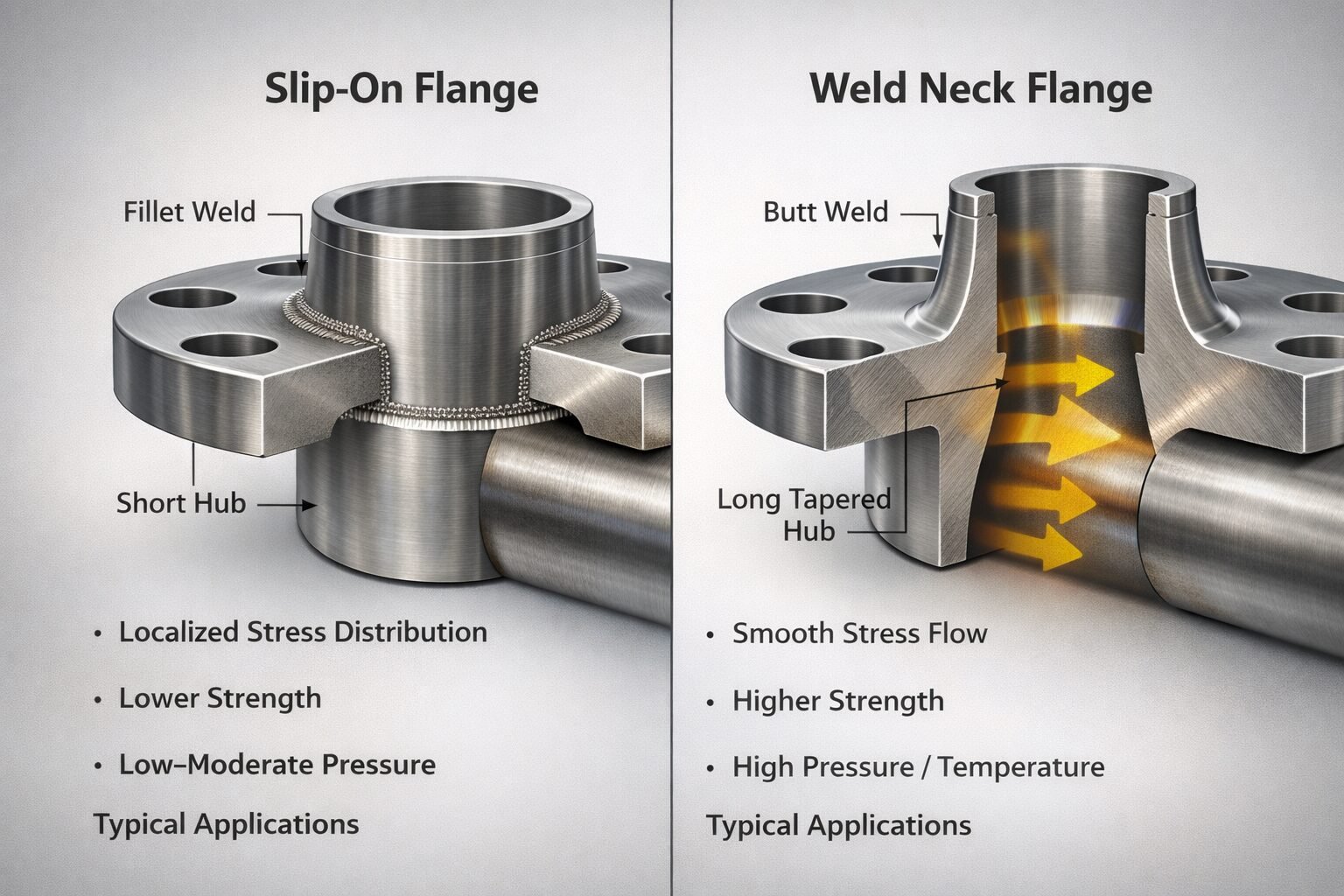
The core difference is in how they connect to the pipe.
- A slip-on flange has a bore that slides over the pipe’s end. It is held by two fillet welds.
- A weld neck flange has a long, tapered hub that is butt-welded to the pipe. This creates a single, strong, full-penetration weld.
2. Performance Under Stress
The weld type dictates performance.
- Fillet welds (on slip-on flanges) are more prone to stress concentration at the weld root. This makes them less suitable for systems with frequent pressure changes, high vibration, or extreme temperatures.
- Butt welds (on weld neck flanges) provide strength equal to the pipe itself. The tapered hub smoothly transfers stress from the flange into the pipe, preventing failure points.
3. Installation and Total Cost
Consider the total project cost, not just the part price.
- Slip-on flanges cost less upfront and are quicker to install. This makes them economical for large-volume, non-critical projects.
- Weld neck flanges have a higher initial cost. However, their durability and reliability in severe service often lead to lower lifetime costs by avoiding leaks, repairs, and downtime.
How to Choose
Use this simple decision guide:
- Choose a Slip-On Flange if: Your system operates at low to moderate pressure and temperature (e.g., water, air, cooling lines). Your priorities are lower initial cost and easier installation, and the system does not experience significant cyclic stress.
- Choose a Weld Neck Flange if: Your system involves high pressure, high temperature, or toxic/hazardous fluids. It is subject to vibration, thermal cycling, or frequent pressure changes. The connection is critical, and failure would be costly or dangerous.
Frequently Asked Questions
Q: Can I use a slip-on flange for high pressure if I use a higher class rating (like Class 600)?
A: The pressure class rating is about the flange body’s ability to contain pressure. However, the inherent weakness of the fillet weld connection remains. For truly high-pressure, high-stress services, a weld neck’s butt-weld design is the safer, standard choice.
Q: Is alignment easier with one type over the other?
A: Yes. Slip-on flanges are easier to align because they can slide on the pipe for final positioning before welding. Weld neck flanges require more precise initial alignment for the butt weld.
Q: Can I connect a slip-on flange directly to an elbow or valve?
A: Usually, no. Slip-on flanges require a straight section of pipe to slide onto. You typically weld a pipe spool to the equipment first, then slide the flange onto that spool.
Conclusion
The choice is not about which flange is better, but which is correct for your specific system conditions. Slip-on flanges offer a cost-effective solution for less demanding services. Weld neck flanges provide the robust integrity needed for critical, high-stress applications.
Need help specifying the right flange type for your pressure, temperature, and application? Our experts can guide you to ensure a safe and reliable specification. Submit your project details for a consultation and quote: http://texasflange.com/lp12/